Five days of finger food, feminism, fraternity and a little fun.
Delegates from 37 European & Scandinavia countries, 22 African countries, 17 from the Asian Pacific region, 16 from the Arab world, 15 from Latin America, and 2 North American countries gathered in Paris. We were to have met at UNESCO headquarters but that was closed to us as the IFJ recognises the trade union rights of journalists in Taiwan. Instead were were ensconced in a Novotel in Bagnolet to the east of the city.
A handful of delegates were prevented from attending having had problems obtaining visas, and eleven unions from Afghanistan, Benin, Bhutan, Bosnia, Georgia-Abkhazia, Germany, Ivory Coast, Jamaica, Russia and South Africa were not present having been suspended for non-payment of fees.
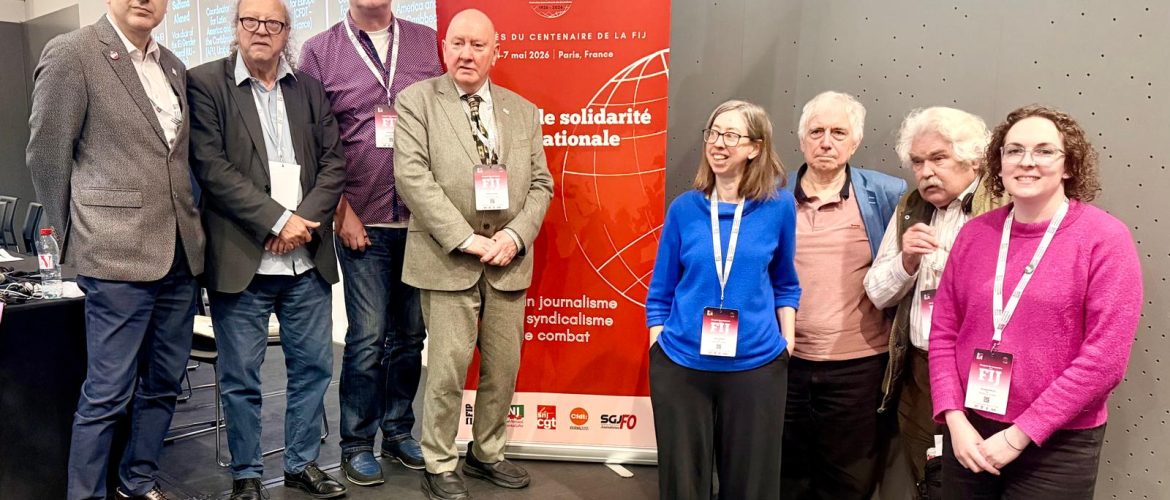
The NUJ (UK & Ireland) delegation was led by General Secretary Laura Davison, Joint President Gerry Curran and Vice President Georgina Morris. They were ably abetted by Jim Boumelha, Seamus Dooley, Mike Jempson, Hanif Mazrooei and Pierre Vicary.
Each delegation is entitled to a certain number of votes, depending on the number of members registered by each union. The NUJ holds the largest number with 9, followed by Germany 8, Egypt & Italy 7, and Brazil 6. Most of the rest had only 1 or 2 votes.
Although a computerised voting system was introduced for critical issues (notably elections to the various prestigious positions within the IFJ) most ordinary and urgent motions were decided on a show of hands. Few were particularly controversial (voting against sin remains a popular pastime).
The new President of the IFJ is Zuliana Lainez the Peruvian journalists’ union leader, a very powerful speaker who was elected unopposed. Her senior Vice- President is London-based Nasser Abu Baker from the Palestine Journalists’ Union; Jennifer Moreau from Canada and Zied Dabbar of Tunisia are the other Vice-Presidents. Italian Raffaele Lorussa becomes the new Honorary Treasurer.
Laura Davison was elected to the new IFJ Executive Committee representing UK & Ireland, with delegates from Angola, Argentina, Australia, Bahrain, Brazil, Cameroon, Colombia, France, Germany, Greece, Indonesia, Korea, Oman, and the USA taking the other spots.
Congress began with a doubled headed seminar at the Théatre de la Concorde near the Champs Elysées.
International law in the service of press freedom with French barristers Louise El Yafi, Inés Davao & Willam Bourdon, Prof. Carmen Draghici from London University and, via Zoom from Australia, Jennifer Robinson (the barrister who effected the release of Wikileaks founder Julian Assange).
Journalism in the age of AI: independence, rights & truth under scrutiny with researchers Dr Konrad Bleyer-Simon (Florence), Refka Payssan (Tunisia) and journalists Zuliana Lainez (Peru), Edward Hasbrouck (USA), & Eric Berbier (France).
These were themes taken up and debated at length during the Congress.
Gender issues featured strongly throughout. A panel of women delegate from Brazil, France, India, Italy, Pakistan, Portugal, Spain, and Uruguay (two African panellists failed to obtain visas) produced a litany of horrendous stories about the abuse suffered by women journalists, notably and appallingly from newsroom colleagues. Social media and the owners of such platforms have much to be ashamed of. Stress was laid on the impact such behaviour can have on mental health, even inhibiting self-expression and encouraging self-censorship.
It is clear that colleagues in the UK are far from being alone in this regard. The NUJ Safety Tracker was mooted as one way of monitoring as such abuse, and there were calls for more international action to challenge online abuse.
Shockingly three complaints were made about sexual harassment by delegates at the Congress itself. One person was excluded and banned from IFJ activities, another has been reported to his member union, and similar action was taken in a third case where no formal complaint was registered.
Repeated efforts to promote formal gender parity within the IFJ caused one of the few ‘hiccups’ at Congress, not least because the NUJ delegation announced support for the principle but expressed doubts about the practicability of demanding positions for ‘at least 11 women and at least 11 men’. Chaos briefly ensued after my only contribution, a Point of Order that by simply accepting an amendment from the floor of Congress a mockery had been made of the original intention – it was no way to proceed. A holy huddle was convened over lunch and NUJ Veep Georgina helped to engineer a satisfactory solution which presented the women of Congress with a win while acknowledging that implementation may not be quite so straightforward as they had hoped.
Journalists’ safety was another running theme at Congress, opening with a message of solidarity from Fabienne Nérac of Reporters Missing in Action. The body of her husband ITN cameraman Fred has never been found. He was caught in the crossfire that also killed his colleague ITN reporter Terry Lloyd on day 2 of the Iraq war in 2003.
We stood in silence to remember so many of our colleagues killed in Gaza and other conflict zones since the last Congress three years ago in Oman. There was a lengthy standing ovation in support of a calls for a rigorous international enquiry into the killings or more than a dozen colleagues by the Israeli Defence Forces (IDF), often in targeted attacks during their current occupation of Lebanon.
A panel discussion on journalism in conflict zones was to feature Marie-Raphaëlle Pierre from Haiti, but she was unable to attend. Sergyi Tomilenko from Ukraine, said colleagues are working under a constant threat from drones. He reported that the IFJ Safety Fund not only provides flak jackets and helmets, but also safe places to work from and support with mental health. He said at least 28 journalists have been detained by the Russians and others have been captured, tortured or killed.
Mohammed Shubaita from Yemen called for financial and moral support for colleagues in what he described as ‘the forgotten war’ in which 60 journalist have been killed, 16 so far this year, some by the IDF. He said 9 journalists are currently detained by the Houthi administration in Sanaa who now control the media.
Nasser Abu Baker reminded delegates that there had been 9,000 aggressive acts against journalists in Palestine over the last 7 years, dating back to long before 7 September 2023. UK, US and Italian journalists as well as many hundreds of Palestinians had been killed by Israelis. Some had been chased by drones, and their family homes deliberately targeted. “Words of solidarity strengthen our struggle to fight for freedom of expression,” he said,
The journalists’ union in Sudan has been dismantled, said Alsadig Ibrahim Ahmed, with many colleagues now in exile. Women and journalists have suffered worst under the militias that split from government forces 3 years ago. In less than a month many journalists had been jailed; others fled abroad or left the profession. At least 20 have been killed, and 20 are missing and 9 jailed in Darfur. He called on the IFJ to find ways to fund those still operating in the country.
At other points in Congress we were reminded of the plight of Swedish Eritrean independent journalist Dawit Ishak languishing in an Eritrean jail since 2001, and the more recent arrest of Swedish journalist Joakim Medin in Turkey facing terrorism charges for investigating Kurdish issues. And we heard about the persecution of journalists in Hong Kong, Syria, and Tunisia.
There was another standing ovation for journalist Mumia Abu-Jamal, now 72 and in the 44th year of a life sentence for a murder he disputes. In a moving message recorded from his Pennsylvanian jail, he spoke about global issues affecting us all.
At the start of Congress NUJ delegates helped to steer through some necessary changes to the IFJ Constitution to bring it into line with current Belgian law, as the main office is in Brussels. And at the end our delegates encouraged dialogue with European unions that had broken away from the IFJ.
The NUJ has a redoubtable reputation within the IFJ, hot on procedure and full of wise counsel, often delivered by Deputy Gen. Sec. Séamus Dooley.
Delegates from all corners of the globe paid tribute to Jim Boumelha, standing down after 30 years on the IFJ Executive (latterly as Treasurer). He returned to the UK laden with all manner of tokens of gratitude but with much responsibility lifted from his shoulders. A veritable guru in the eyes of many, he has been a lynch-pin in IFJ efforts to support colleagues during the crises in the Middle East. He can now concentrate on his Oxford allotment.
Georgina Morris spoke to our motion calling for a windfall tax on the ‘Tech Giants’ everywhere, and won backing for the IFJ to engage with the International Trades Union Confederation (ITUC), Public Services International (PSI) and the Network of Unions for Tax Justice (NUYJ) to advance a UN Framework Convention on International Tax Co-operation.
An NUJ amendment encouraging unions to adopt our approach to seeking out, supporting and bringing into membership colleagues forced out of their countries by war and persecution, was incorporated within a motion from French, Spanish and Kosovan unions calling for solidarity with exiled journalists.
Public service broadcasting is under attack around the world, Congress heard from Annick Charrette (Canada), Antoine Chuzeville (France), Laura Davison (UK & Ireland), Michiko Kurita (Japan), and Raffaele Lorusso (Italy).
Resolutions were passed demonstrating the determination of journalists everywhere to protect their independence from political or commercial interference, in the Czech Republic, Nepal, Pakistan and Switzerland. Indian delegates were disparaging about unethical ‘lapdog journalists’ who simply echo the narratives of government and corporations.
Surveillance of journalists also featured strongly. Samar Al Halal from Social Media Exchange in Lebanon introduced her truly terrifying report Global Surveillance of Journalists: A Technical Mapping of Tools, Tactics and Threats which is available on the IFJ website. Séamus Dooley reported on the extent of police surveillance in the North of Ireland, and Samira de Castro spoke about the Basilian experience under Bolsonaro.
Authors rights were debated following a round table with Anita Huss-Ekerhult, Secretary General of the International Federation of Reproduction Rights Organisations (IFRRO), and American copyright expert Edward Hasbrouck, who paid tribute to the sterling work of the NUJ’s Mike Holderness on copyright issues over many years.
Judging by the number of references in contributions from the floor of Congress the universal bêtes noires of delegates were Artificial Intelligence, precarity and the Far Right, evidence if nothing else of how much we share with colleagues around the world.
The IFJ continues to campaign for a Convention Against Impunity in the struggle to defend the rights of journalists, and organises a myriad of training programmes among affiliated unions. We were treated to an update on the activities of the IFJ Global Media Youth Group. Applications to join are open to new candidates under the age of 35 from member unions.
An advertised speech from Julian Assange did not materialise but we did hear from 2021 Nobel Peace Prize laureate, award-winning dissident Russian journalist Dmitri Muratov in a witty video in defence of press freedom.
Luc Triangle, General Secretary of the ITUC paid tribute to journalists who put their lives at risk to preserve freedom of speech. Citing the hundreds killed in the last year, he said attacks on journalist are an attack on democracy and that is an assault on all workers. He urged support for a global Convention in defence of journalists rights. Condemning the wealthy who control the law and blame everyone but themselves for society’s ills, he reminded delegates that the labour movement is the world’s largest social action group and if and when we work together we can make change happen.
BBC World Service veteran Pierre Vicary shared the envious task of chairing sessions of Congress as part of a 5-person Praesidium charged with managing business.
According to my notes a total of 51 ‘ordinary’ motions were approved by Congress, with one ‘reference back’ Another eight emergency motions also won support from delegates. Most were introduced with a 2 minute proposal; only 1 minute was allowed for any opposition (an opportunity rarely taken up), then motions were put to the vote. If a delegate was not present when their motion was called, it was passed on the nod if there was no sign of opposition.
It was not all ‘work’ of course.
The Moroccan born Deputy Mayor of Paris Mme Lamia El Aaraje delivered a lengthy welcoming speech when we paid an evening visit to the city’s ornate Hotel de Ville. A unique fusion of music from the 13 refugees who form Utopia here and now, serenaded us before we filed off to fill up with finger food and fizzy wine.
There was more of the same next night on the Seine in the rain. This time the cruise, music, wine and finger food was sponsored by Maria Antoniadou, President of the Journalists’ Union of Athens Daily Newspapers. Her union would later present every delegate with a pewter medal commemorating the IFJ centenary!
And on the last night we were sped up to the 11th floor of the magnificent Arab World Institute in glass lifts, to be welcomed by the recently appointed French Minister of Culture Catherine Pégard.
As a former political journalist, she should have felt at home, but faced by hungry journalists from around the world, she appeared nervous. Perhaps she was anxious that awkward questions might be asked as she has inherited a struggling ministry from a predecessor, Rachida Dati, who now faces corruption charges. And she herself had once been a speech writer for disgraced former president Sarkozy.
However as the sun went down, many delegates were more entranced by the amazing views through the extraordinary windows of the Institute across Paris to Notre Dame and the Eiffel Tower. And there was a fresh supply of finger foods to savour, with appropriate beverages to be quaffed.
A groovy combo soon had delegates letting their hair down – dancing and singing to Sting’s ‘Englishman in New York’, the Internationale and Bella Ciao. Duty done, a good time was had by all.
On a personal note, this was my first, and probably last Congress, despite having worked for the IFJ many times in many countries over the years. I was able to touch base with successors to union leaders I had worked with in post-conflict zones in the past, and catch up with an old friend, former NUJ activist and IFJ General Secretary Aidan White, who paid a flying visit.
I also made contact with some of the new generation of colleagues who now promote our rights and responsibilities as defenders of press freedom in Cameroon, Canada, Iraqi Kurdistan, Sri Lanka, Yemen and more.
To cap it all I was chuffed that my translation of the memoirs of an Armenian in the French Resistance formed part of the NUJ’s parting gift to current IFJ General Secretary Anthony Bellanger. Tout est bien.
